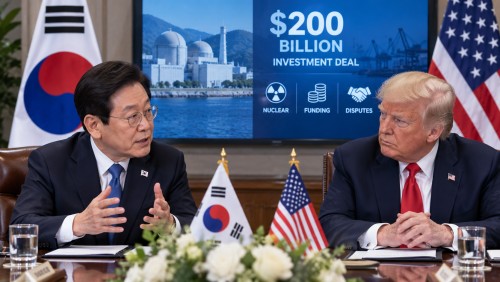
Amid ongoing negotiations, South Korea and the United States are striving to iron out significant differences concerning a substantial $200 billion investment by Seoul in the U.S. The talks have encountered hurdles primarily in the areas of nuclear projects, funding schedules, and the allocation of investment risks, which have cast uncertainty over the finalization of the agreement.
A prominent sticking point in the discussions is the construction of nuclear reactors, an area where both countries are yet to reach consensus. Plans include constructing eight reactors in the U.S., with six based on Westinghouse’s AP1000 design and two utilizing South Korea’s APR1400 technology. However, U.S. officials and Westinghouse have reportedly resisted the inclusion of the APR1400, complicating the nuclear project aspect of the deal. South Korea, in turn, has shown interest in acquiring a 15% to 20% stake in Westinghouse, which contrasts with Westinghouse’s preference to keep Seoul’s ownership under 10%.
Further complicating matters, South Korea is considering involvement in a U.S. project for processing spent nuclear fuel and a proposed liquefied natural gas project in Alaska. However, concerns about construction costs and long-term profitability remain significant barriers to progress.
The financial arrangement between the nations is also under negotiation. The U.S. has requested that South Korea provide over $9 billion by the end of the year, whereas South Korea had initially proposed a smaller contribution in 2026, with plans to increase funding from 2027 onwards. This divergence in funding schedules is a critical issue yet to be resolved.
Moreover, the two countries are at odds over the calculation of investment returns and losses. South Korea advocates for profits from successful ventures to mitigate losses from unsuccessful ones, whereas the U.S. prefers a project-by-project return calculation. Under the proposed framework, the U.S. would receive 90% of net profits post recovery of principal and interest, a point of contention for Seoul, which fears bearing losses from unsuccessful projects while the U.S. benefits from profitable ones.
Despite these challenges, both governments continue to negotiate the terms of the investment package. South Korea’s Industry Ministry has underscored that discussions are ongoing and that no definitive decisions have been made regarding the investment’s final structure and scope.