
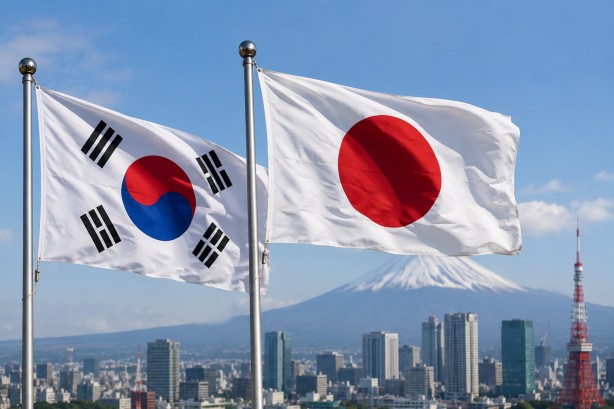
Under the leadership of Prime Minister Sanae Takaichi, Japan’s political trajectory is leaning more conservative, posing new challenges to its relationship with South Korea. This shift raises concerns that longstanding historical and territorial issues might hinder the recent diplomatic efforts between the two nations. Traditionally, South Korea and Japan have adopted a “two-track” strategy, which aims to separate emotionally charged historical disputes from areas of mutual cooperation, such as security and economic partnerships. However, a report from South Korea’s Institute for National Security Strategy has highlighted potential threats to these diplomatic gains, citing Japan’s political instability and its move towards the right as factors that could impede bilateral progress.
Recently, tensions have flared up, driven by visits of Japanese politicians to the Yasukuni Shrine, a site that often sparks controversy due to its historical associations. Additionally, Japan’s renewed assertion of sovereignty over the Dokdo islets, known as Takeshima in Japan but controlled by South Korea, has further strained ties. Prime Minister Takaichi opted not to visit the shrine on August 15, the anniversary of Japan’s World War II surrender, although she did send a ritual offering. Despite her absence, visits by other senior Japanese officials to the shrine prompted official protests from South Korea.
In response to these developments, South Korean President Lee Jae Myung has maintained a balanced stance, recognizing historical grievances yet stressing the increasing importance of cooperation with Japan. The diplomatic landscape remains delicate, as experts caution that unresolved disputes over historical and territorial issues, as well as controversies linked to wartime events, could undermine the “two-track” framework. For this strategy to remain effective, it is crucial for both countries to achieve concrete progress while simultaneously broadening their areas of practical cooperation.
This complex dynamic underscores the intricate nature of Japan-South Korea relations, where historical wounds and territorial disagreements persist as formidable obstacles. Despite these challenges, both nations continue to recognize the necessity of collaboration, especially in areas that bolster their mutual interests. The path forward will require careful navigation to balance historical sensibilities with the pressing need for strategic partnership.