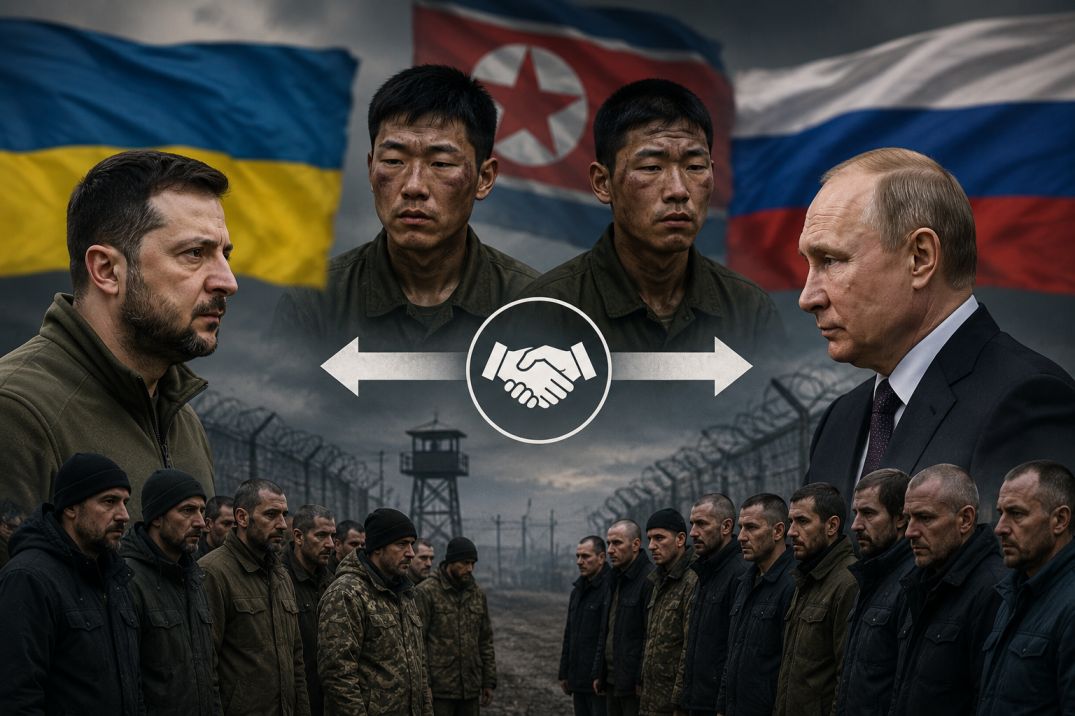
In a surprising turn of events, Russia has reportedly put forth a proposal to swap thousands of Ukrainian prisoners of war for two North Korean soldiers captured by Ukraine. This information emerged during Ukrainian Foreign Minister Andrii Sybiha’s visit to South Korea, where he discussed the matter with South Korean Foreign Minister Cho Hyun. Although the proposal, if confirmed, could significantly impact diplomatic negotiations, several diplomatic insiders have expressed skepticism over whether Moscow would indeed propose such an extensive exchange.
The discussions took place in Seoul, where Sybiha engaged with South Korean officials and participated in dialogues at the Asan Institute for Policy Studies. Sources familiar with the private meetings indicated that Sybiha mentioned Russia’s suggestion to return the North Korean soldiers to Pyongyang in exchange for the release of Ukrainian detainees held by Russia. These comments were reportedly intended to highlight the complex political decisions facing Kyiv, rather than to announce any formal negotiation process.
As the situation unfolds, Ukraine finds itself grappling with the challenge of balancing humanitarian concerns against the imperative to secure the return of its citizens. Meanwhile, South Korea has made clear its readiness to accept the two North Korean soldiers should they choose to resettle there, aligning with its constitutional view that North Koreans are citizens of South Korea. Ukrainian authorities have also emphasized that they will not forcibly repatriate the prisoners if they do not wish to return, although a final decision on the matter remains pending.
Amid these developments, diplomatic conversations between South Korea and Ukraine have broadened to consider Seoul’s possible involvement in Ukraine’s post-conflict reconstruction efforts. Ukraine has shown interest in South Korea’s participation in rebuilding infrastructure and energy facilities critical to the nation’s recovery. However, Seoul has maintained that the humanitarian issues concerning the prisoners of war are distinct from broader reconstruction cooperation or other forms of aid.
The fate of the two North Korean soldiers, captured in Russia’s Kursk region in January 2025, remains uncertain as both countries continue to engage in consultations guided by international law and humanitarian principles. This case marks the first known instance of North Korean troops being captured alive after deployment in support of Russian military operations, adding layers of complexity to the ongoing diplomatic discussions, which now intersect with broader regional security and humanitarian obligations.