
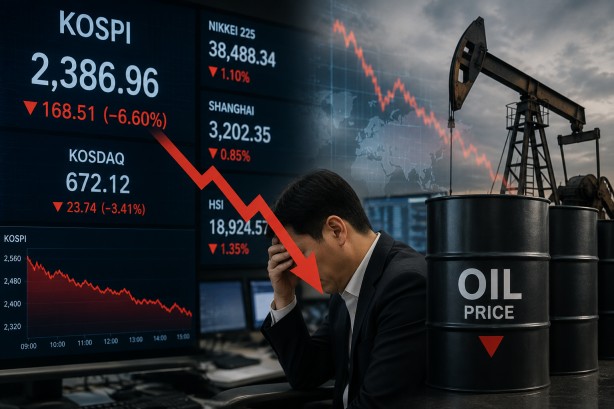
On Thursday, Asian stock markets predominantly saw declines, prominently highlighted by a significant 6.6% plunge in South Korea’s Kospi index. This downturn came amid a surprise interest rate hike by the Bank of Korea, which exerted pressure on the market, alongside substantial losses in the technology sector. Notably, SK Hynix experienced a sharp drop of 11.2%, and Samsung Electronics fell 8.2%, contributing to the overall market slide.
Elsewhere in Asia, Japan’s Nikkei 225 index also faced a considerable decline, shedding 2.9%. The fall was primarily driven by losses in companies associated with semiconductor production, such as Kioxia, Tokyo Electron, Advantest, and SoftBank Group. Meanwhile, Taiwan’s Taiex index dipped slightly by 0.3% as investors awaited the earnings report from major chipmaker TSMC. In China, the Shanghai Composite index decreased by 0.9%, while Australia’s S&P/ASX 200 ended the trading day with a minor loss.
In contrast to these regional trends, Hong Kong’s Hang Seng Index rose by 1.7%, buoyed by gains in Alibaba shares. This positive movement followed the approval of a new AI service in China powered by Alibaba’s Qwen model, adding a boost to the market despite the general downward trend seen in other Asian markets.
Concurrently, oil prices witnessed a slight drop but remained at elevated levels due to ongoing geopolitical tensions. Brent crude saw a decrease of 0.4% to settle at $84.55 per barrel, and US crude dropped by 0.2% to $79.34 per barrel. The persistent concerns regarding potential disruptions to shipping through the Strait of Hormuz continued to underpin oil prices despite the day’s decrease.
On the other side of the globe, US stock markets closed higher the previous night. This optimistic close was supported by new data indicating easing inflation and robust corporate earnings, providing a counterbalance to the more turbulent developments in Asian markets.