
The standing stones of West Cornwall hold knowledge encoded in their placement four thousand years ago. These granite monuments aren’t randomly distributed but follow patterns that reveal sophisticated astronomical understanding. The Land’s End peninsula emerges from archaeological research as an integrated ceremonial landscape designed to track and celebrate the winter solstice—the moment when darkness reaches its maximum before the sun begins its return journey.
Geological features provided the foundation for this astronomical landscape. A granite ridge extends southwest along the peninsula, naturally aligned with winter solstice sunset direction. Carolyn Kennett’s research demonstrates how Neolithic communities recognized this alignment’s significance and enhanced it through strategic monument construction, creating observation points where people could gather to witness solar phenomena during the year’s critical turning point.
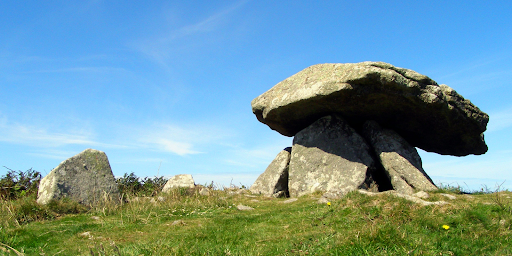
Chûn Quoit exemplifies the precision of prehistoric astronomical architecture. The chambered tomb occupies a position ensuring winter solstice observers see the sun descending precisely behind Carn Kenidjack’s distinctive rocky summit. This alignment required detailed knowledge of solar movements across the year and suggests astronomical observation held profound cultural significance for these communities.
Tregeseal stone circle adds another dimension to this astronomical network. From within the stone ring, observers can view the Isles of Scilly appearing and disappearing on the southwestern horizon. This visual instability may have reinforced beliefs about western directions as gateways to supernatural realms, with the winter solstice representing a moment when such boundaries became permeable.
The enigmatic Kenidjack holed stones present ongoing archaeological mysteries. Their small apertures positioned low to the ground suggest specialized functions, possibly related to tracking changing sunlight patterns through autumn. Modern engagement with this heritage combines scholarly research with community celebration. The Montol festival revives traditional Cornish customs including masked dancing, ritual sun burning, and torch-lit processions, maintaining vital connections between contemporary communities and the astronomical knowledge embedded in their ancient landscape.