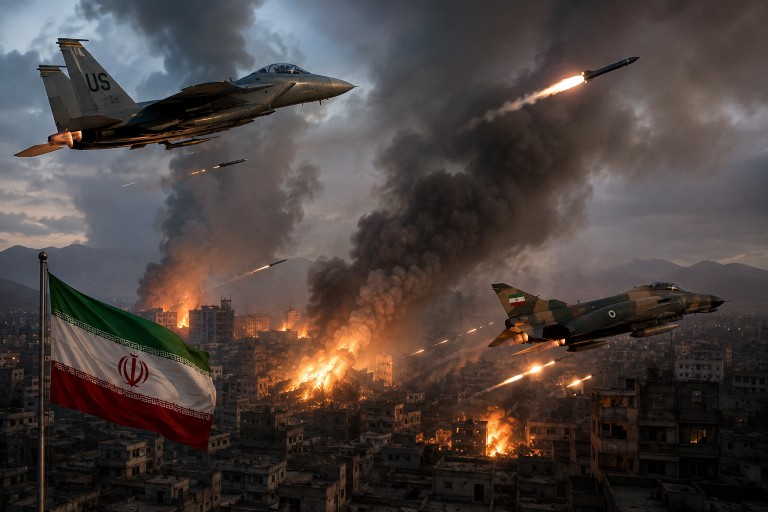
The United States and Iran have once again engaged in a series of airstrikes, intensifying fears of escalating tensions that could spiral into a wider conflict across the Middle East. The U.S. military launched attacks against sites linked to Iran’s Islamic Revolutionary Guard Corps (IRGC), which they claim were in retaliation to Iran’s attempts to disrupt commercial shipping in the Strait of Hormuz and threats directed at American personnel.
In response, Iran executed missile and drone strikes targeting U.S. interests in several countries throughout the region, including Jordan, Bahrain, Kuwait, and Iraq. Jordan’s armed forces reported intercepting ten ballistic missiles fired from Iran, with three additional missiles landing in isolated areas. There were no immediate reports of casualties or direct hits on the U.S. military training facility in Jordan. Meanwhile, Iran asserted responsibility for attacks on a U.S. base near Erbil in Iraq, and similar military activities were noted in Kuwait, prompting air-raid sirens in Bahrain.
This surge in military action has intensified concerns regarding the security of the Strait of Hormuz, a vital corridor for global oil transportation. The recent conflict has already led to a rise in oil prices, with Iran threatening to block oil exports from the Gulf if the United States ramps up its military or economic pressure. Iranian authorities have denounced the latest U.S. strikes and have pledged to retaliate. President Masoud Pezeshkian has indicated that Tehran is ready to respond if the United States does not adhere to earlier agreements intended to prevent conflict.
Despite these tensions, both nations have issued warnings about the potential for further attacks to provoke stronger responses. U.S. President Donald Trump has signaled the possibility of a much more aggressive retaliation should Iran continue its assaults, while Iranian leaders have vowed to defend their interests through both military and diplomatic avenues. The current situation marks a shift from recent months, where the focus had moved away from direct military engagements towards economic sanctions, blockades, and other forms of pressure. The recent military exchanges threaten to undermine these efforts, raising the specter of renewed and sustained military conflict in the region.